

The IT industry stands on the brink of one of its most transformative eras, triggering major consolidations in many long-standing sectors and the emergence of major new markets. IDC’s latest research shows that the infusion of autonomy, adaptability, and decision-making into products and services with agentic AI is redefining the very foundation of technology design, delivery, and value creation. It goes beyond an evolution in AI adoption. It’s a structural shift that will determine which technology providers lead in the emerging agent economy and which struggle to adapt.
Agent Use Will Surge 10x by 2027
IDC predicts that by 2027, G2000 agent use will increase tenfold, with token and API call loads rising a thousandfold [FutureScape 2026; Category: Worldwide IT Industry; Prediction 2]. For technology providers, this is a customer adoption story and a capacity challenge. Every software provider, cloud platform, and hardware vendor will need to optimize compute delivery, token use/delivery efficiency, and orchestration tools to manage unprecedented scale. Vendors that help enterprises measure, govern, and contain the costs of agentic automation will become essential partners in the next phase of digital transformation.

The Coming Surge: Agents, Actions, and Industry Transformation
IDC developed our new Agent Economics Adoption and Delivery Model to provide a foundation for tracking the worldwide pace and scale of agent adoption by type of agent and to extend that tracking by geography and sector over the next 5 years.
In our first release, IDC projects that the number of actively deployed AI agents will exceed 1 billion worldwide by 2029 which is 40 times more than in 2025. They will include in-application and standalone agents built and operated by cloud, software and services providers, but they will also include a growing number of custom-configured (no code/low code) and bespoke agents optimized to address the unique needs of individual enterprises.
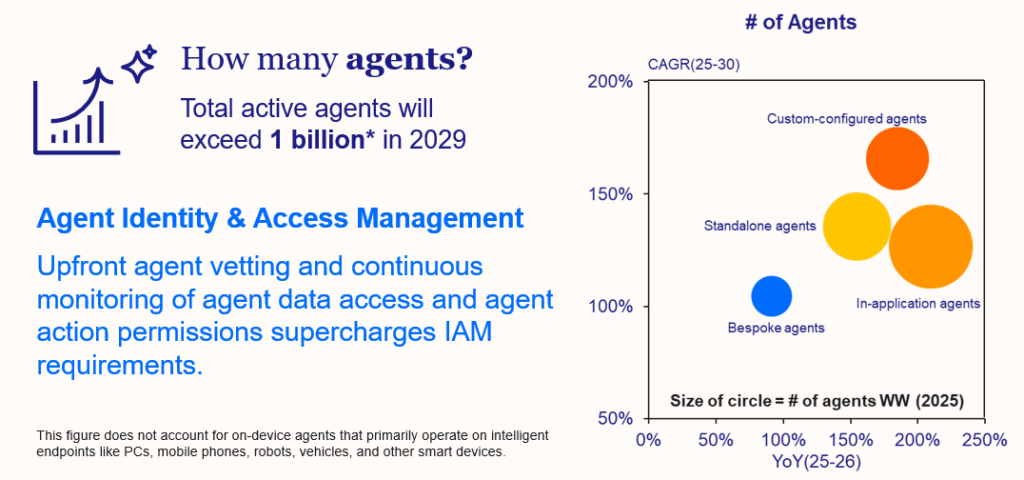
More significantly, these agents will execute over 217 billion actions per day and consume 3.7 TeraTokens/Calls (3,700,000,000,000) daily to support this still rapidly expanding inferencing load. The token delivery cost worldwide for supporting all these agent actions will surpass $68 billion annually, but the cost to complete an ever more complex and sophisticated individual action will be 87% lower.
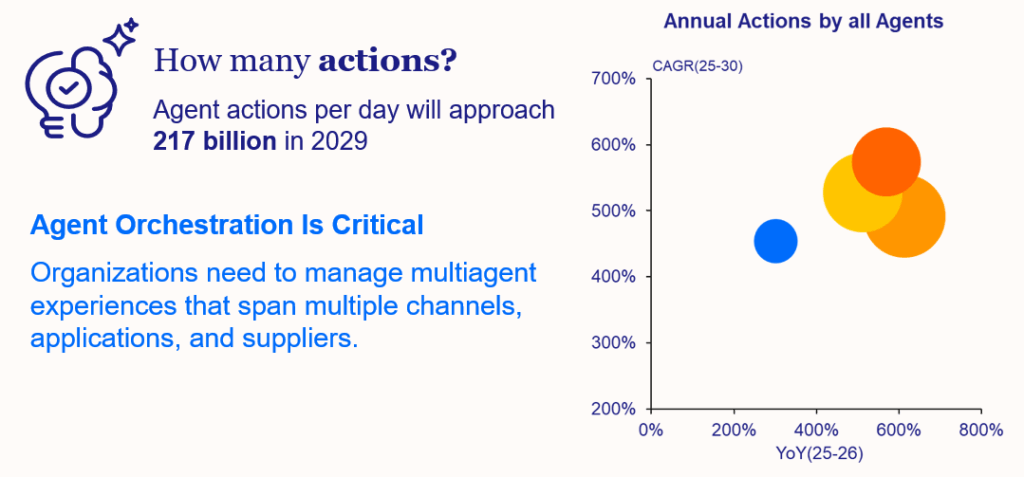
For the IT industry, this represents both a windfall and a reckoning. The software, infrastructure, and service providers who can enable this scale efficiently will dominate the market. Those who can’t because they are still tied to monolithic licensing models, siloed architectures, or restricted data practices will see margins shrink as automation commoditizes legacy value propositions.
Applications Become Agentic Platforms
A critical early driver of agent adoption and token load growth comes from IDC’s Worldwide AI-Enabled Enterprise Applications and Agents 2026 Predictions which forecasts that by 2027, agentic automation will enhance capabilities in over 40% of enterprise applications [FutureScape 2026; Category: AI-Enabled Enterprise Applications and Agents; Prediction 1]. This signals a new design imperative for the IT industry: applications are becoming actors, not just interfaces.
The winners will be those who transform products into platforms built on collaborative ecosystems of agents that anticipate user intent, orchestrate processes autonomously, and continuously optimize operations through feedback. This agentic pivot will blur the boundaries between software, infrastructure, and services delivery, pushing the entire IT industry toward modular, interoperable architectures.
Data Readiness Becomes a Competitive Advantage
Data is the lifeblood of the agent economy. IDC warns that by 2027, companies that fail to establish high-quality, AI-ready data foundations will suffer a 15% productivity loss as generative and agentic systems falter [FutureScape 2026; Category: Worldwide Agentic Artificial Intelligence; Prediction 1]. For technology providers, this means opportunity. The leaders will be those that offer the tools to unify data governance, enhance observability, and create federated architectures, fueling agents with trusted, real-time intelligence.
A New Tech Industry Transformation
For the IT industry, the coming years will bring a massive reallocation of value. Demand for hardware optimized for AI inference and training will surge. Cloud providers will see unprecedented pressure on network and compute resources. Software vendors will need to evolve beyond seat-based licensing toward models that measure value by actions, outcomes, and intelligence generated. Managed service providers, in turn, will need to automate their own operations with agentic platforms that deliver speed, transparency, and scale.
IDC’s research underscores that as agents proliferate; the IT industry must take on a new role: the orchestrator of autonomy. Providers will no longer just deliver technology; they will deliver the frameworks that govern intelligent digital resources by balancing efficiency, ethics, and economic sustainability.
Building the Foundation of the Agentic Economy
For technology providers, the time to act is now:
- Engineer for scale and sustainability. Design architectures and platforms that can handle the exponential growth in agent numbers, actions, and token/call demand.
- Reimagine pricing and delivery models. Move beyond seats and licenses to outcome-based models that reflect continuous, autonomous operation.
- Champion data integrity. Invest in AI governance, observability, and interoperability to ensure agents operate with accuracy and accountability.
- Embrace modularity and interoperability. Partner across ecosystems to create open, agentic frameworks that integrate seamlessly with others.
- Lead with responsibility. As agents gain autonomy, establish ethical guardrails and compliance mechanisms that earn enterprise and public trust.
The IT industry has faced transformation before, from mainframes to client/server, to cloud, and now to AI-infusion. The question for every provider is no longer if this transformation will happen, but whether they will steer it.
For IT leaders and technology providers, the path forward is clear.
Design for orchestration. Deliver for scale. Govern for trust.
Success in agent economics will belong to those who can turn autonomy into advantage and help the world’s enterprises navigate this next great inflection point with confidence.